
Financial due diligence · AI and control
The CSVs went into an AI tool. Would you base the acquisition on it?
A large business that acquires regularly said it had no need for Insitely. The financial CSV files simply went into an LLM and the analysis came out smoothly. That this works is not in question. The question is a different one: would you also base the acquisition decision on it?
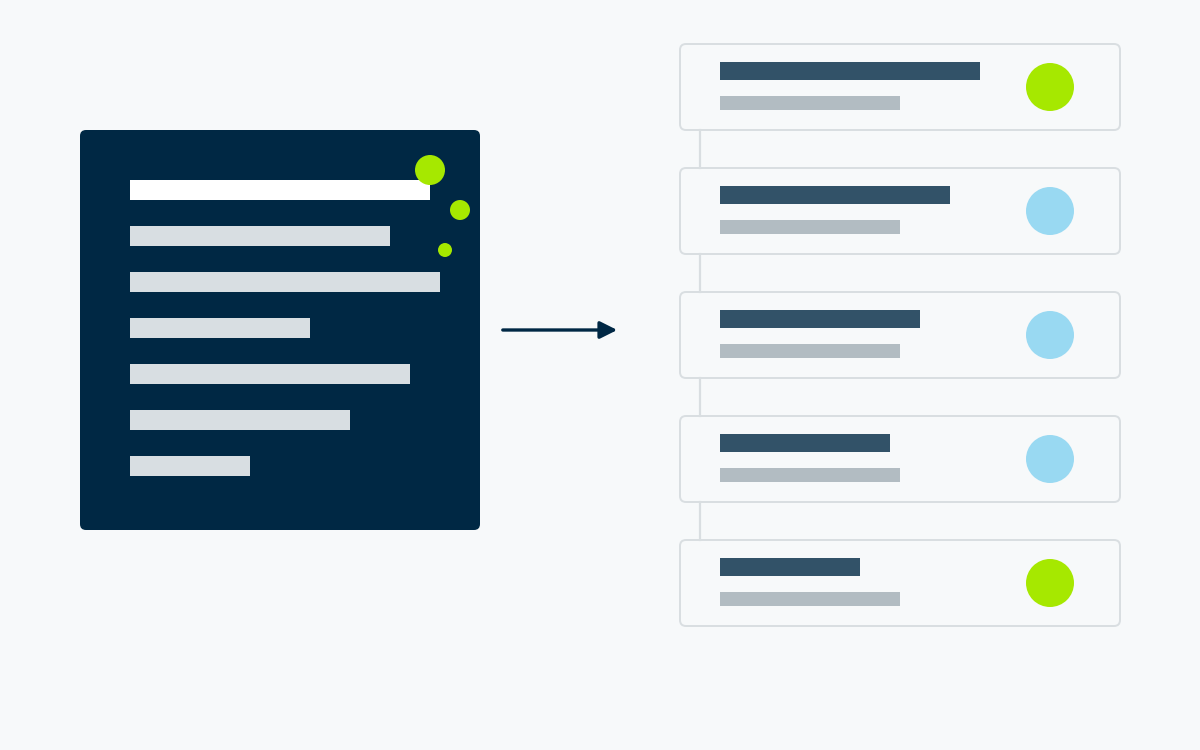
Let one thing be clear: at Insitely the attitude towards AI is decidedly positive.
AI is used there to support software development, for R&D and to explore new benchmarking and analysis methods. It speeds up the work and helps test ideas faster. The output is checked and tested before it becomes part of the product or of a financial analysis.
So AI is not the opponent of Insitely. Quite the opposite.
But a convincing answer is not yet a verifiable analysis.
A plausible answer is not evidence
Give a language model a few CSV files and a clear prompt and it can name trends, flag outliers and summarise tables at speed. For a first exploration that is valuable.
A financial due diligence asks for more. The analysis can help determine what a buyer pays, which warranties end up in the agreement and whether the transaction goes ahead at all.
At that point the answer alone is not enough. You also need to be able to demonstrate:
- that all relevant files and periods have been processed in full;
- that revenue, margin and balance sheet reconcile to the source figures;
- which mappings, corrections and assumptions were applied;
- that the same processing leads to the same explainable result again;
- who reviewed the outcome and takes responsibility for it.
A language model can produce a convincing and confident answer without showing whether every file, period and exception was interpreted correctly. That does not make an LLM unusable. It does mean that fluently expressed confidence is not a control method.
Did the selling party agree to this?
An acquisition file contains confidential information: customer names, prices, margins, personnel data, contract details and detailed postings. Did the target know that this data was being fed into an AI system? Does that fit the data room arrangements, the confidentiality undertakings and the internal information security policy?
Which AI environment was used in this particular case is not known. It may have been set up properly with suitable contracts and technical safeguards. It may not have been. Which is exactly why a few questions need answering up front:
- Where are uploads and results processed and stored?
- Who can gain access to them?
- Is the information used to train models further?
- What happens to the uploaded files once the analysis is done?
"It is in our AI tool" says nothing about where that data ends up, who can look at it or how long it stays there.
A second AI model is not an audit
You can have the same analysis carried out by a second LLM. Differences point straight to further investigation. If both reach the same result, you still do not know that it is correct.
They can misread the same column, miss the same missing period or make the same faulty assumption. Agreement is a useful sensitivity test but not a reconciliation with the accounts.
The real control is less spectacular:
- Reconcile the loaded data with the source files and the accounting totals.
- Record mappings, filters, calculations and manual corrections.
- Make exceptions and uncertainties visible.
- Keep a reproducible trail from source to end result.
- Have an experienced analyst assess the financial meaning.
That is the difference between getting an answer and being able to defend an analysis.
AI as an assistant, a fixed data layer as the foundation
So AI does not have to stay out of an acquisition file. It can help a great deal with exploratory analysis, hypotheses, outliers, code and documentation.
But the financial base should not be recreated at every prompt.
Insitely retrieves available data from supported accounting systems through a secure connection and structures it in a repeatable data process for Power BI and Excel. That gives a consistent financial data layer first. On top of it AI can help search, compare and explain while the analyst keeps hold of the controls and the professional judgement.
Use AI to reach better questions and insights faster. Not to skip the verifiability of the underlying figures.
An LLM that delivers an analysis within minutes is impressive. In an acquisition the decisive question stays the same:
Can you demonstrate that the answer is complete, correct, securely processed and reproducible? And if not: would you really base the acquisition on it?
How is AI used in your DD process today?
Where does AI move your analysts forward today and which controls deliberately stay outside the model? In a substantive conversation we put your process alongside the combination of a fixed data layer, human validation and targeted AI support.
About Roel Bäumer
Eighteen years in data and BI by now, with medium to large businesses. With Insitely I combine a reusable financial data layer with implementation and M&A data expertise. Where a file calls for extra analysis or bespoke work, I can also join an existing deal team as a data specialist.
Further reading: Why detailed general ledger data is indispensable in financial due diligence