
Financial due diligence · Case from practice
We could not even count the customers
How many customers does this business have? How many of them come back? And what share of revenue comes from the largest customers? These are basic questions in a financial due diligence. Even so, we could not answer them.
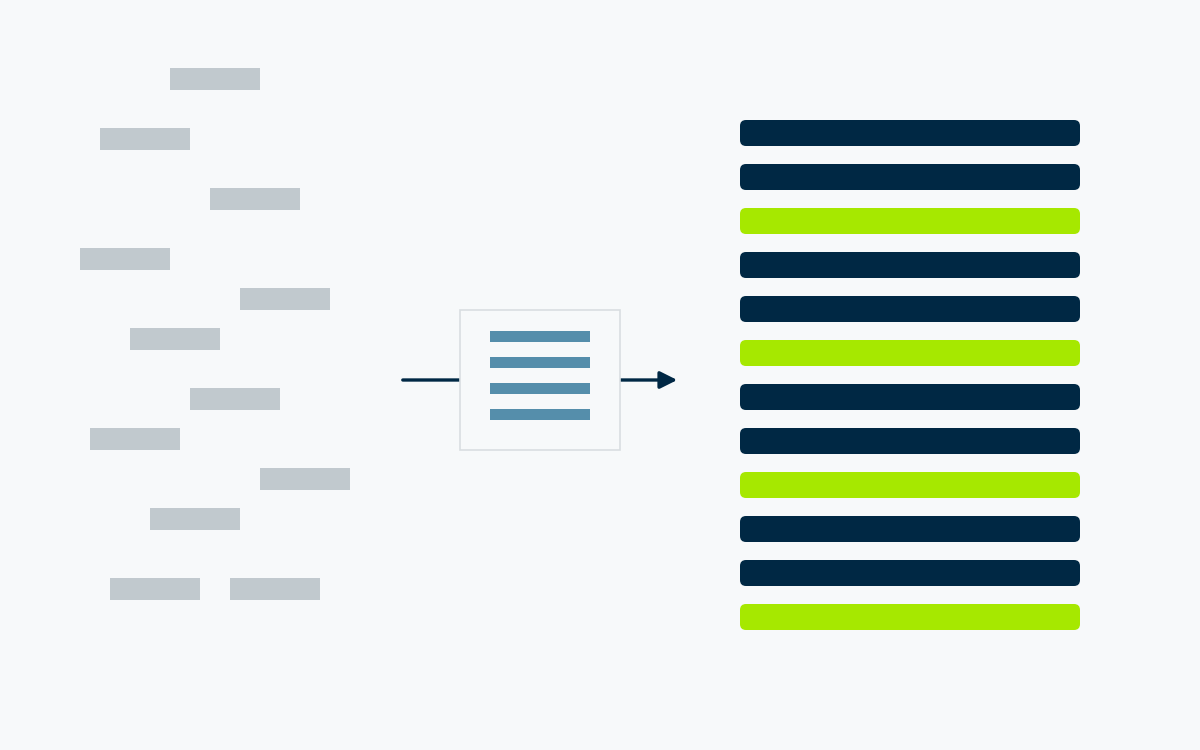
Acting for the buy side, I carried out the financial and commercial data analysis during an international acquisition. My brief was clear: deliver the dashboards and insights the CFO and the deal team needed to understand the business behind the numbers.
When the customer analysis questions came up, I thought: easy.
Until I opened the data.
No customer ID. Not even a unique key field
The sales data we received held no customer ID. There was no other unique key field either, nothing that let us follow a customer reliably across the different tables.
What did we have? Customer names. Except those names were not stable. They were spelt differently, edited along the way, or padded with internal remarks.
On that basis you can group rows that resemble one another. What you cannot do is say with any confidence how many unique customers there are, which customers buy again, or what share of revenue sits with a single customer.
My first reaction was mostly disbelief: how can a business not be able to count or segment its own customers reliably?
This analysis is exactly what a buyer needs
The CFO's questions were not unusual. A buyer wants to know:
- how many active customers the business has;
- how many customers return;
- how heavily revenue is concentrated in a few large accounts;
- which types of customer are served;
- which countries or regions those customers sit in;
- how stable and recurring the revenue base is.
In this deal the eventual customer and revenue analysis grew into one of the decisive elements of the purchase decision. That was the very analysis we could not run reliably at the start.
Reconstructing the customers first
There was no magic Excel formula that made the problem disappear. Before we could analyse anything, we had to make the customers recognisable again.
I received separate customer lists and compared them with the available sales data. Using fuzzy matching, I looked for correspondences across different combinations of customer name, address, postcode, country and other available attributes.
Every proposed match was assigned a match score. At a score of 85 out of 100 or higher, the sales team accepted the suggested customer number. Below that threshold, they reviewed the match manually. The customer number was then added to the customer record so we could carry it into the analysis.
That approach worked because we did not hide the uncertainty. Strong matches could be processed quickly and human attention went to the doubtful cases. Only after we had rebuilt a missing piece of the data structure could the real analytical work begin.
The data we were missing sat closer than we thought
During that work it became clear what I actually needed: direct, structured access to the most detailed accounting data.
The accounts often hold a great deal of usable customer information. Depending on the package you find it in the general ledger lines, the sales invoices, the debtor cards or the customer records.
Connect those sources to each other and to the commercial sales data in a controlled way and you get a verifiable overall picture. You no longer have to recognise customers from shifting names alone.
In a financial due diligence, make sure the analyst has access to every relevant data source and not only to summary reports. Think of general ledger lines, sales invoices, debtor information and where needed the CRM or sales data as well.
This is where the need for Insitely became visible
The Insitely tool did not exist at the time. The need for it became very clear during this engagement.
Today, where the data is available in a supported accounting system, Insitely retrieves detailed general ledger postings, sales invoices and customer records through a secure connection. That data is structured for analysis and made available in Power BI and Excel.
The same two environments, as it happens, in which I had to deliver my dashboards and insights during that due diligence.
Not because financial due diligence can do without Excel. Rather because an external analyst spends their time better on analysis and professional judgement than on repairing exports.
How does your DD process run today?
How do you gather, connect and verify financial and commercial data in a DD file today? In a substantive conversation we put your process next to this case. A focused demo can then show where Insitely takes time and manual work out.
About Roel Bäumer
Eighteen years in data and BI by now, with medium to large businesses. With Insitely I combine a reusable financial data layer with implementation and M&A data expertise. Where a file calls for extra analysis or bespoke work, I can also join an existing deal team as a data specialist.
Further reading: Which customer analyses are indispensable in an acquisition?