
Financial due diligence · Data process
From accounting system to Power BI and Excel without copy and paste
Excel and Power BI are rarely the problem in financial due diligence. The problem usually sits in everything that has to happen before the analysis can start.
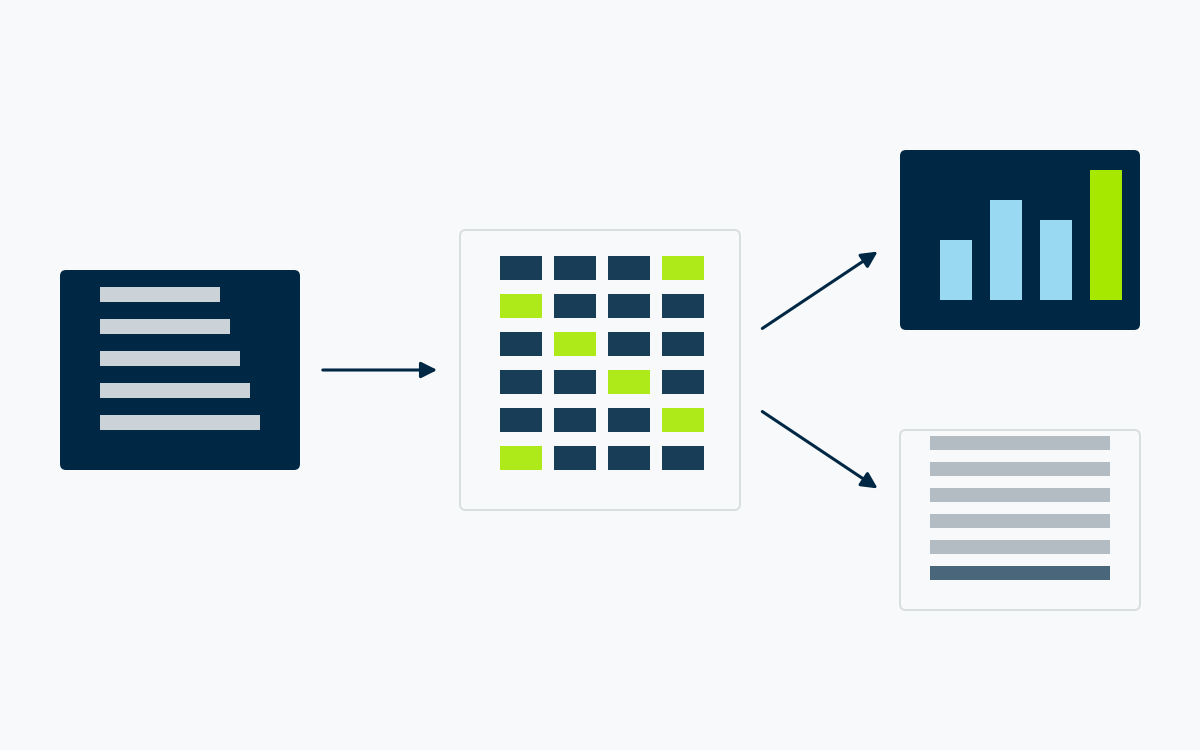
Ask a financial analyst how much time goes into real analysis and how much into gathering and repairing data. The answer is not always comfortable.
Requesting files. Receiving new exports because a column is missing. Merging worksheets. Mapping account numbers. Correcting data types. Aligning customer names. Reconciling totals again. And repeating part of that work when a new version arrives.
Some of that preparatory work is necessary. It simply does not have to become the same Excel marathon for every DD file.
The classic export process
A traditional data process tends to look roughly like this:
- the analyst draws up a list of requested files;
- the business or the accountant produces exports from various systems;
- files are checked for periods, fields and completeness;
- tables are cleaned and combined by hand;
- accounts and dimensions are mapped;
- results are reconciled to existing reporting;
- only then does the substantive analysis begin.
When a source file changes, shifts or is delivered again, part of the preparation can start over. That does not only lengthen the lead time. It also makes it harder to reconstruct exactly which operation produced which figure.
Why more Excel is not always the answer
Excel remains a remarkably powerful analysis tool. I still deliver insights in Excel myself. The trouble starts when one workbook has to be data source, cleaning process, mapping layer, control file and final report all at once.
That is where the risks creep in:
- manual changes are hard to repeat;
- formulas point at different file versions;
- business logic is scattered across tabs;
- controls become person dependent;
- a new period asks for a great deal of preparation again.
So the answer is not to banish Excel from the process. The answer is to let Excel start where Excel is strong: analysing, checking and judging professionally.
Start as close to the source as you can
A safer and smoother process starts with the secure connection to the accounting system. Where the data is available there, detailed general ledger postings, sales invoices and customer records can be retrieved and structured directly.
That brings three advantages.
1. Less interpretation at extraction
You depend less on someone deciding in advance which columns or tables end up in an export. The relevant source data can be processed to a fixed structure.
2. The same logic can be applied again
Mappings, transformations and checks do not have to be rebuilt by hand at every update. That makes the process more repeatable.
3. The link to the detail is preserved
A dashboard figure can be traced back to the underlying postings or invoices, as far as that data is available in the source. It helps the analyst investigate exceptions faster.
Automation does not replace the financial analyst. It stops their expertise being spent on work that is the same every time.
Power BI and Excel, not Power BI or Excel
In financial due diligence both tools have their place.
Power BI is strong for interactive dashboards, trends, segmentation and exploring larger volumes of transaction data. A CFO or deal team can move quickly from a total to a specific customer, account or period.
Excel stays familiar for detail checks, bespoke calculations, scenarios and sharing analytical work within a deal team.
Insitely therefore makes the structured financial data available in both environments. Not to dictate how an experienced analyst works but to make the distance between accounting system and analysis a great deal shorter.
What stays human work?
A smooth data process does not mean every financial conclusion is automatically right. The analyst is still needed to:
- set the scope and definitions of the analysis;
- assess exceptional transactions;
- explain differences on their merits;
- determine which trends are material;
- translate findings into risk, value and a purchase decision.
That is exactly why trust matters so much. The tool organises the data layer. The financial professional guards the meaning.
How Insitely supports this process
Where the relevant data is available in a supported accounting system, Insitely retrieves it through a secure connection. For Belgian files the accounting data is mapped to an analysis model based on the Belgian minimum chart of accounts, the MAR.
The data is then made usable for analysis in Power BI and Excel. That gives a verifiable and reusable base without an external analyst having to rebuild loose exports for days first.
Insitely did not come out of a theoretical software model. The need became visible in real financial and commercial data engagements where apparently simple DD questions ran aground on missing structure and inaccessible source data.
A tool where it fits, expertise where it is needed
Not every DD file drops straight into a standard model. Sometimes additional data sources have to be connected, a reliable key is missing, or the link between sales and finance needs further investigation.
In those files you can call on my implementation and M&A data expertise alongside Insitely. For instance to:
- get the necessary data sources and keys clear up front;
- connect financial and commercial datasets reliably;
- set up mappings, reconciliations and data quality checks;
- build dashboards and detail analyses in Power BI and Excel;
- investigate exceptions and data risks together with the M&A team.
Not as a replacement for the M&A adviser or the CFO but as a specialist data and BI consultant alongside the existing team. Insitely stays my core focus. The consultancy makes sure more complex files can land on a reliable data layer too.
How smoothly does your DD data process run?
We do not start with a general product presentation. First we look at how you gather, check and analyse data today. Where useful I can help sharpen what is missing from my consultancy experience. A focused demo then shows how Insitely can streamline the repetitive part of that process.
Discuss your DD process and book a focused demo
About Roel Bäumer
Eighteen years in data and BI by now, with medium to large businesses. With Insitely I combine a reusable financial data layer with implementation and M&A data expertise. Where a file calls for extra analysis or bespoke work, I can also join an existing deal team as a data specialist.
Read the case: We could not even count the customers